
50 shades of stop loss, Part 1/2
Our Trading lifecycle and execution semantics milestone is now feature complete. Hey LiSA can express the full lifecycle of a trade: entry, sizing, protection, updates, and exit.
For this study, we designed six BTC strategies on the 4h chart. They all use Supertrend 10/3 as their entry signal: a bullish flip opens a long, and a bearish flip opens a short. Each trade risks 2% of the portfolio. An opposite flip closes any position still open.
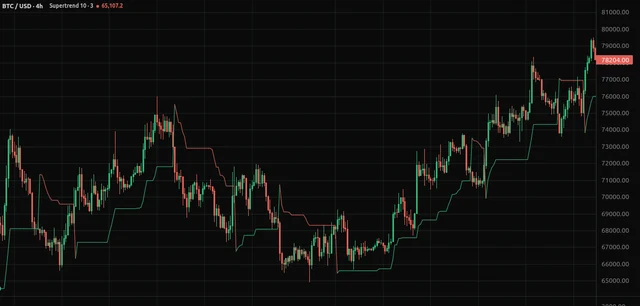
Each strategy is tested over the same six-month period.
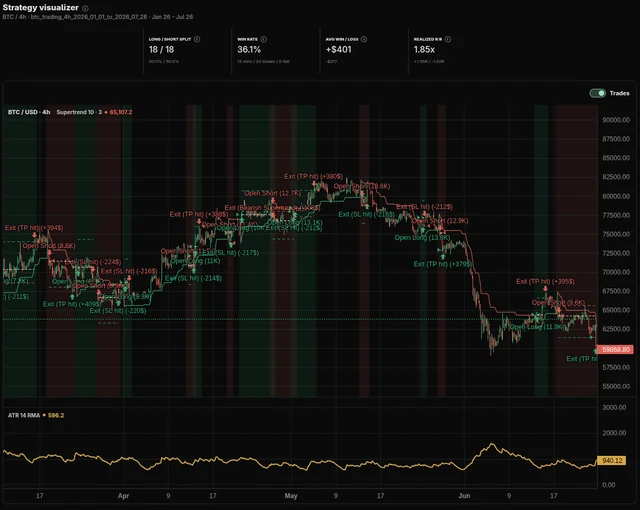
The six strategies differ only in how they manage an open position: fixed price, ATR, market structure, RSI invalidation, trailing ATR, or time. These are examples, not a complete list.
Each strategy starts as a natural-language instruction. We selected one clear trade from each backtest and zoomed in to show how Hey LiSA applies its rules candle by candle.
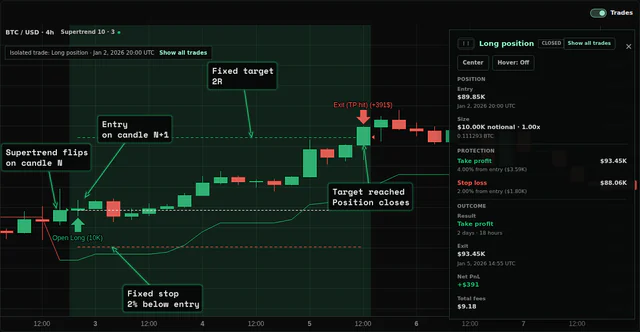
1. Fixed price protection
Trade BTC on 4h using Supertrend 10/3 for entries. Risk 2% of the portfolio per trade. Place the stop 2% from entry and use a 1:2 risk to reward ratio.
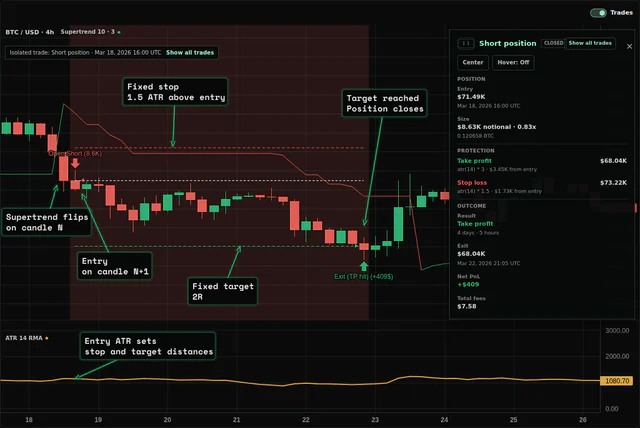
2. Volatility based protection
Trade BTC on 4h using Supertrend 10/3 for entries. Risk 2% of the portfolio per trade. Place the stop 1.5 ATR from entry, using ATR(14) at entry, and use a 1:2 risk to reward ratio.
3. Market structure protection
Trade BTC on 4h using Supertrend 10/3 for entries. Risk 2% of the portfolio per trade. For longs, place the stop at the previous candle’s 20 candle Donchian low. For shorts, use the Donchian high. Target 1.5R.
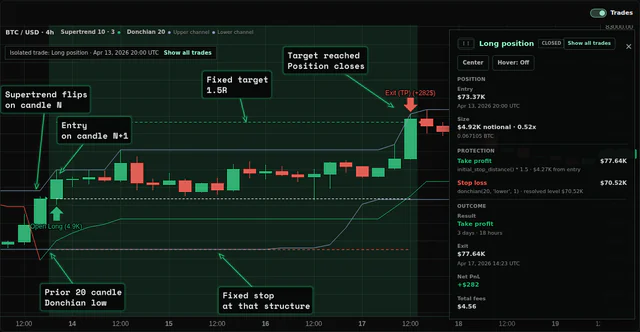
4. Condition invalidation exit
Trade BTC on 4h using Supertrend 10/3 for entries. Risk 2% of the portfolio per trade. Use a 2% emergency stop and a 2R target. Use RSI(14) as an exit indicator. Invalidate a long when RSI is 50 or lower, and a short when it is 50 or higher.
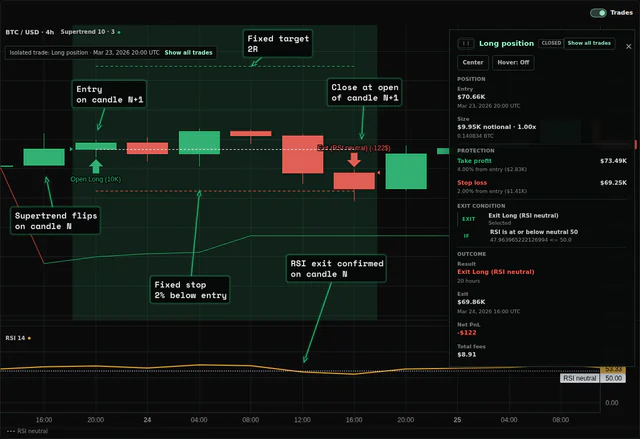
5. Dynamic trailing protection
Trade BTC on 4h using Supertrend 10/3 for entries. Risk 2% of the portfolio per trade. Start with a 2 ATR stop, using ATR(14) at entry. Once the trade reaches 1.5R, trail the best price by 3 current ATR. The stop can only tighten.
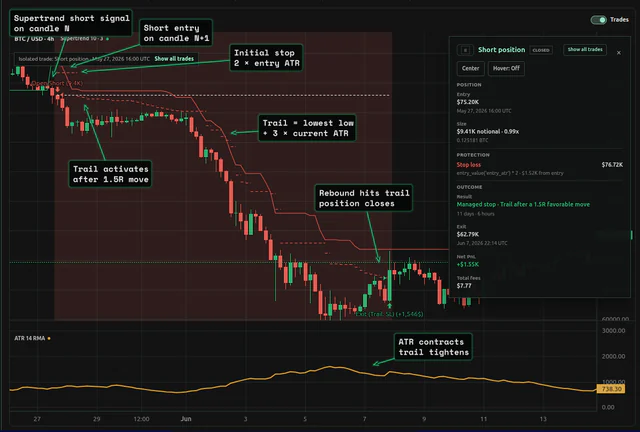
6. Time based exit
Trade BTC on 4h using Supertrend 10/3 for entries. Risk 2% of the portfolio per trade. Use a 2% emergency stop and a 2R target. Close the position if it is still open after 20 candles.
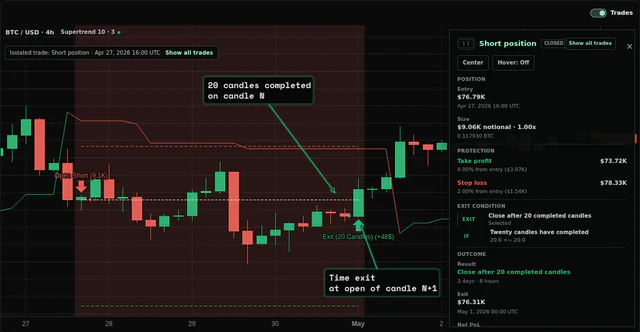
Part 2 combines several of these mechanisms in one NNFX based strategy: a two leg trade with TP1, TP2, and a trailing stop. It is a more complete example of what the engine can express in one approach.