
U can’t beat Bitcoin DCA with no plan
Research dollar cost averaging.
Hal Finney, BitcoinTalk, 2011. Source
Hey-LiSA starts from a simple idea: being able to backtest/execute any trading strategy expressed in natural language, on any market, on any timeframe.
That is a big problem.
For the first Strategy Lab PoC, we had to simplify:
First we removed selling from the problem. That removes exits, stops, position closing, and a lot of risk-management logic.
We also removed lump sum and reduced the problem to a simple daily flow: $50 comes in every day, how do you use it? Something people can easily relate to.
And we decided to focus on the king of assets: Bitcoin, on the daily chart.
Once those simplifications are done, there is still an infinite set of strategies, an infinity of ways to answer the question every day: buy Bitcoin or accumulate cash?
What do you do with $50 a day and the daily Bitcoin chart?
The first answer that comes: a pure DCA strategy.
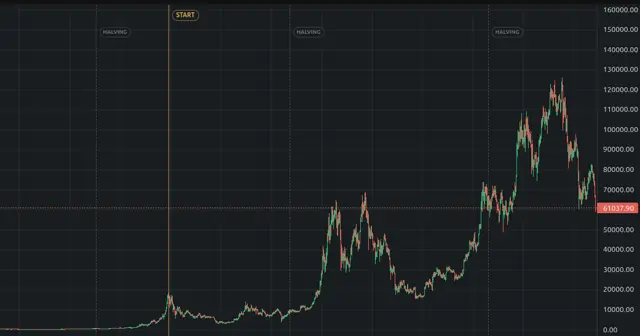
The simplest strategy, besides doing nothing and holding USD, the one that comes first to mind: pure DCA, Dollar Cost Average, and the endless family, the infinite collection of strategies that come from it, enhanced/improved DCA, based on every possible rule, indicator, signal, and idea.
It is the simplest plan: buy $50 of BTC today, repeat tomorrow, then all the following days. It looks stupid, but it is already extremely hard to beat.
Backtesting Engine
To start Strategy Lab, we had to develop our own homemade strategy scripting language + runtime, expressive enough to describe any real computable strategy: a state machine, variables, conditions, loops and action blocks, built-in indicators, external data for on-chain indicators, etc. Everything had to fit inside the same language.
Designing our own homemade scripting language also helps us keep the grammar as simple as possible, which helps AI agents one-shot strategies correctly most of the time, from conversations, articles, PDFs, or even directly from PineScript/Python/JS/etc. That is critical for later, but that part is for later, while reducing complexity and attack surface as much as possible.
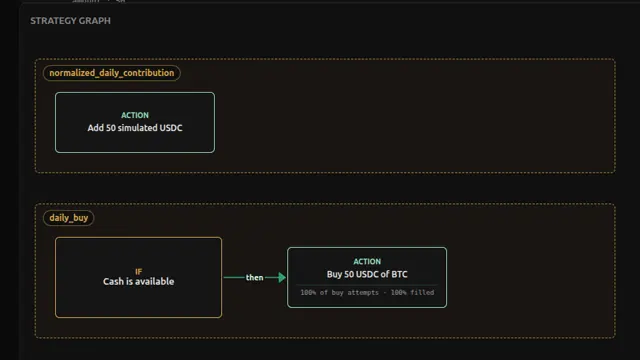
With this stack in place, it becomes possible to test a whole family of DCA strategies, from the simplest to the most advanced or even stupid ones, but the first one we put through Strategy Lab is also the simplest of all: deploy the $50 allocation into BTC every day. Pure Daily DCA. It is the dumbest strategy in the lab, and it is also, no surprise, one of the best and hardest to beat, better than a lot of traders.
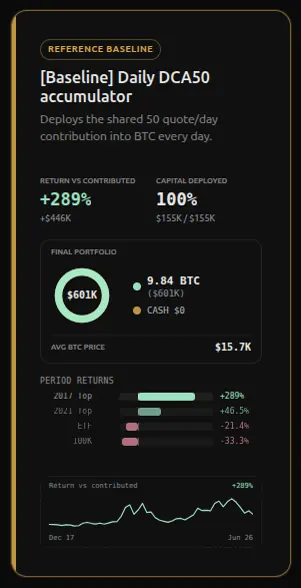
Same rule, more periods, DCA is a beast
Yes. Everybody already knows that daily Bitcoin DCA works. But it is always good to repeat: Strategy Lab shows that $50 of BTC invested every day from the 2017 cycle top like a maniac gives you almost 10 BTC accumulated, with a chad average entry around $15k/BTC, and about 150k invested.
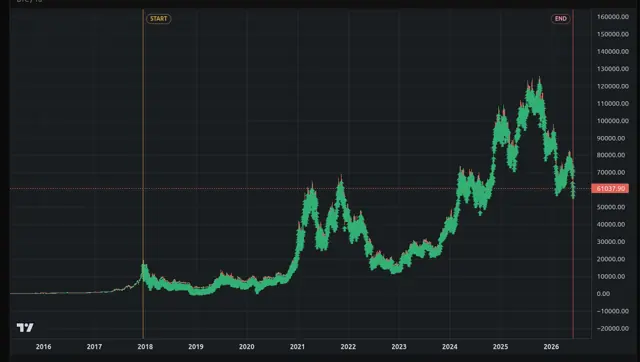
And yeah, it also means $5/day would have been enough to accumulate 1 BTC. One full shiny Bitcoin, for the price of a coffee.
Key Bitcoin periods
Of course, the earlier DCA starts, the better the results.
To avoid building around one cherry-picked window, we extended the test bench across several key periods of recent Bitcoin history:
- 2017 Cycle Top → Today: starts near the December 2017 cycle top, one of the worst possible entry points at that time, and crosses bear market, recovery, then ETF era.
- 2021 Cycle Top → Today: starts around the 2021 cycle top, to test DCA through the post-top drawdown, the 2022 bear market, and the long recovery after.
- ETF Cycle: starts around the spot ETF launch, to test DCA in the modern higher-price regime, without an obvious cheap-BTC accumulation window.
- First 100K Cycle: starts when BTC first touched 100K on the daily candle, a period a lot of new entrants can relate to, and one of the worst possible recent entry points.
Later, we will add more periods and try to normalize strategies by cycle regimes. Maybe even all the way to electing the best one. But that is slippery ground.
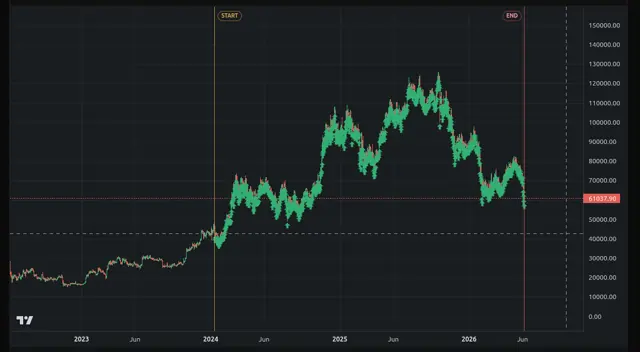
Since 2017 and 2021, even with bad entry points, daily DCA had enough time to do its dirty work. It kept buying while everyone hated BTC, drastically lowering the entry price.
On the opposite side, the ETF Cycle, or the symbolic 100K passage, is not the perfect entry point, to say the least.
With $77k average entry on ETF Cycle and $91k on First 100K Cycle, both strategies are currently underwater and can stay underwater for a while. DCA is not a cheat code. Or maybe it is, but only if you give it enough time horizon.
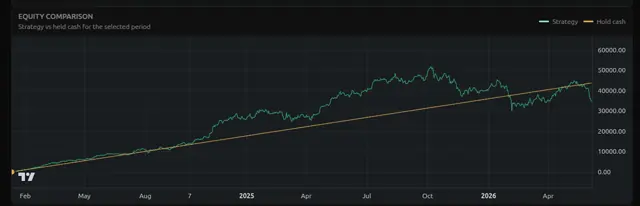
How to beat DCA?
Pure DCA is already an ultra-solid BTC investing strategy. Boring, easy to execute, with better results than most traders.
With the next article, we will show more Strategy Lab features that let us test a whole set of strategies around DCA:
- technical indicators: the whole gang
- on-chain indicator series: ever wondered what DCA enhanced with CBBI or MVRV does?
- tools to compare strategies with each other
- inspection and observability tools for each trade: to know why a trade was taken by the engine
- more complete trading metrics to judge strategy quality: CAGR, max drawdown, volatility, Sharpe, Sortino, win rate, profit factor, time in market, cash deployed vs cash idle
and a lot more stuff :)
What do you do with $50 a day and the Bitcoin chart? And does your strategy beat DCA?
With Strategy Lab in our hands, we can now test a whole lot of improved strategies and compare them to the pure DCA baseline, and answer those questions without having to guess.
Backtesting any strategy, at the speed of thought, that is the idea.